CleanPaws
Turning dog-waste cleanup into a community win
The Problem Was Never Awareness
Dog waste on NYC sidewalks isn't a mystery. Everyone sees it, everyone knows it's a problem, and as of February 2026, NYC has received close to 1,000 complaints about it. But complaints don't translate to change. Neighborhoods with the highest rates often have the fewest free bags or accessible bins, and enforcement requires an officer to witness the act, making the Pooper-Scooper Law nearly impossible to enforce at scale.
The gap isn't knowledge. It's infrastructure and incentive.
What the Research Showed
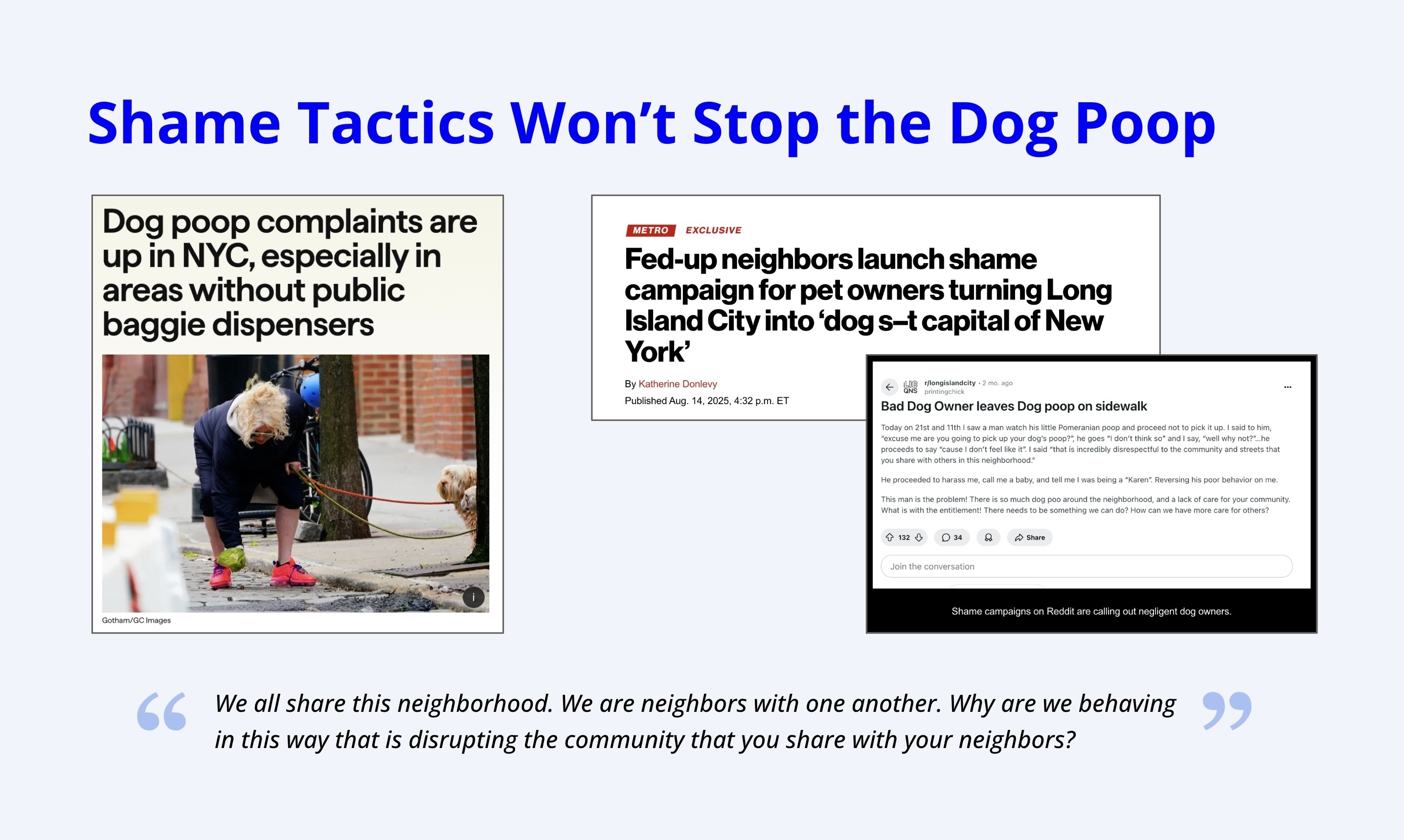
The default response has been awareness campaigns, and almost every one leads with shame. The NYC Department of Sanitation has run campaigns calling out repeat offenders. Neighborhoods have posted signs publicly naming individuals. These efforts get attention, but they don't change behavior.
The research pointed to something more fundamental: shame creates resistance, while recognition creates momentum. A 2019 study in Frontiers in Psychology found that when collective progress is made visible, even the least-engaged participants contribute at levels comparable to those already committed. When cleanup feels like contributing to something shared rather than avoiding a fine, people show up differently.
The data made the case, but what stayed with me was the story underneath it. People actually want to do the right thing. They just need a reason that feels good, not a reason to feel watched.
"I asked myself: what would it look like to create a solution that supports the behavior we want — instead of relying on catching people doing the wrong thing?"
The Prototype
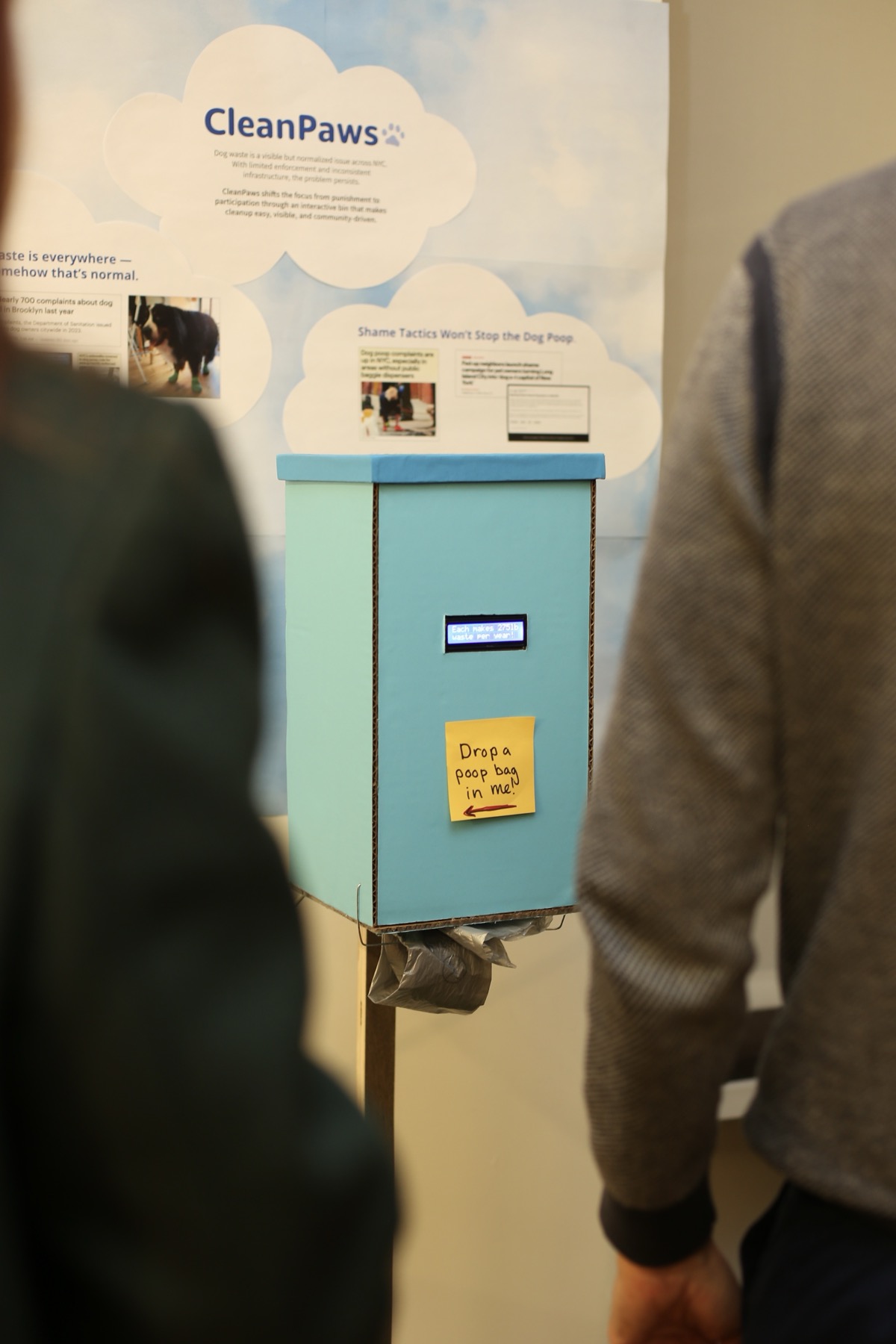
CleanPaws is an interactive dog-waste station designed for sidewalks and parks. Built with an Arduino and a load cell, it detects when a bag is dropped in and responds in real time. The station combines a waste bin, a built-in bag dispenser, and a small screen.
The interaction is intentionally small. Drop a bag, get a response. The screen lights up with a friendly message and plays a chime, just enough to acknowledge the action without overstating it.
A fullness meter under "Every Bag Counts" updates with each deposit, giving people immediate feedback that their action moved the needle.
When the bin reaches capacity, the station briefly celebrates by cycling through a series of environmental impact screens, each one translating the collective effort into something tangible. One example: 96 million gallons of water protected, enough to supply 877 NYC households.
The final screen reads "Community makes it happen." The numbers give people a reason to believe their action counts. The framing gives them a reason to care.
What Testing Revealed
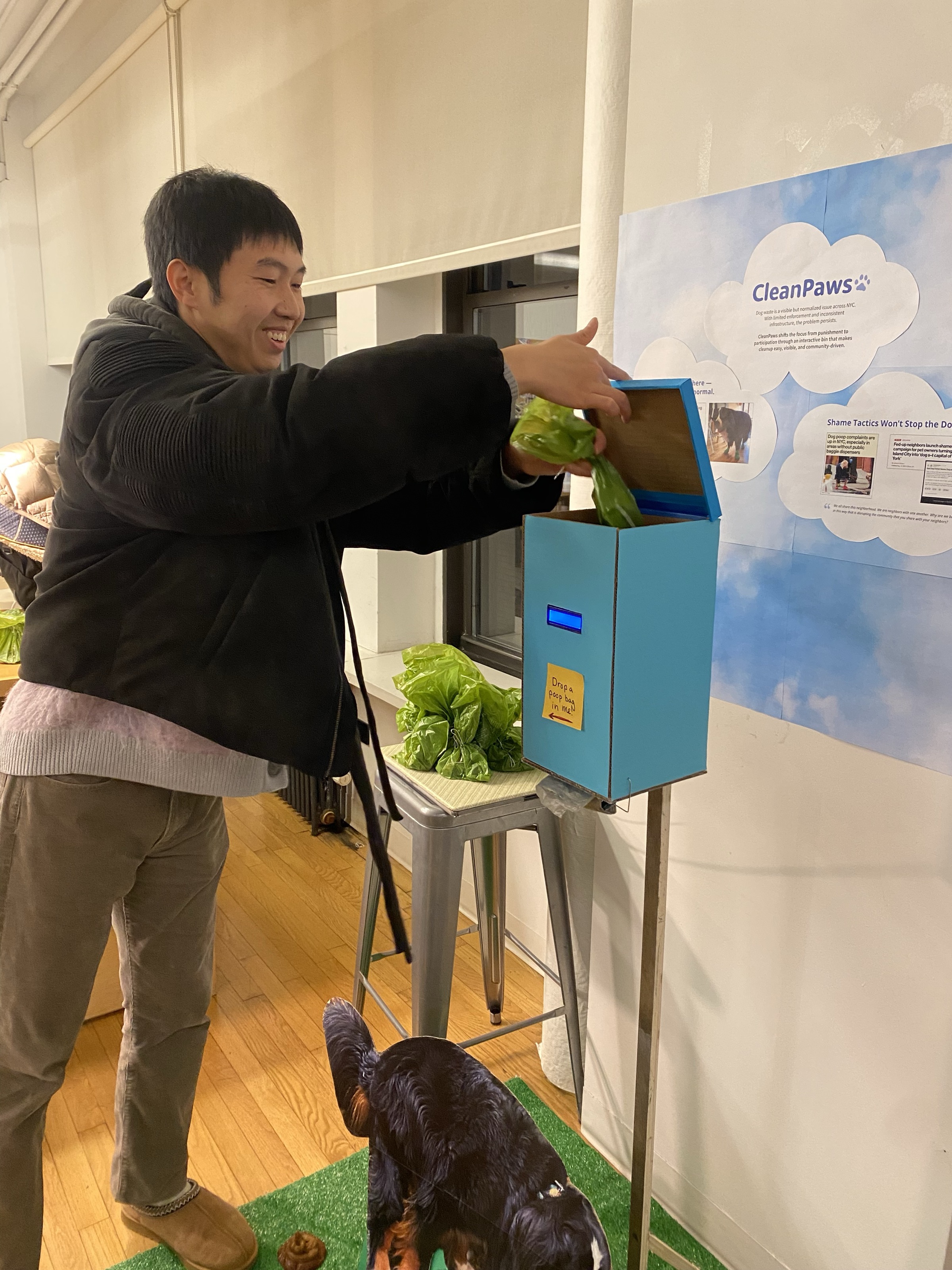
People genuinely enjoyed the interaction. The chime and message made cleanup feel good rather than obligatory, and the impact data helped people connect a small action to something much larger.
What This Makes Possible
CleanPaws reframes a compliance problem as a participation opportunity. The infrastructure removes the barrier, the feedback makes the action feel worthwhile, and the collective data gives an everyday habit a larger meaning. At scale, a network of stations across NYC neighborhoods could shift how communities relate to shared public spaces, turning a source of frustration into a visible measure of collective care.
What I Took Away
Data builds credibility, story builds memory
Numbers alone don't move people, but numbers with context do. "96 million gallons of water protected" lands differently than a statistic on a poster because it gives people a way to picture the impact of something they just did.
Design for behavior, not compliance
Positive feedback loops outlast punishment and awareness campaigns. Making an action feel good is more sustainable than making people feel guilty, and a lot more interesting to design.
Infrastructure is half the solution
A free bag dispenser isn't a design detail. It's the thing that removes the most common excuse. Sometimes the most impactful design decision is making the right thing easy.